AI Quality Inspection Without a Data Science Team — How QuaVision Makes It Possible
The AI Barrier in Manufacturing
Everyone in manufacturing has heard the pitch: AI will transform your quality inspection. Fewer defects, higher throughput, lower costs. The promise is real — but so is the barrier.
Most manufacturers who explore AI inspection quickly hit the same wall. They are told they need a data science team. They need to select frameworks, label thousands of images, tune hyperparameters, manage training pipelines, and maintain models in production. For a mid-sized manufacturer running sorting machines and inspection stations, this is not a realistic starting point. The expertise is expensive, the timeline is long, and the risk of a failed pilot is high.
What if the barrier did not have to exist?
The QuaVision Approach: You Train It Yourself
QuaVision, our proprietary vision software platform, was designed from the ground up with one principle: the people who know the product best should be the ones teaching the system what to look for.
That means your quality engineers. Your machine operators. The people who already know what a good part looks like and what a defect looks like — because they have been making that judgment call every day for years.
Here is how it works in practice:
Step 1 — Mark the defects. The QuaVision GUI displays inspection images from your production line. Your operator marks the areas that show defects — scratches, cracks, dents, discolourations, whatever is relevant to your product. No annotation tools from a research lab. Just a clean, intuitive interface designed for the factory floor.
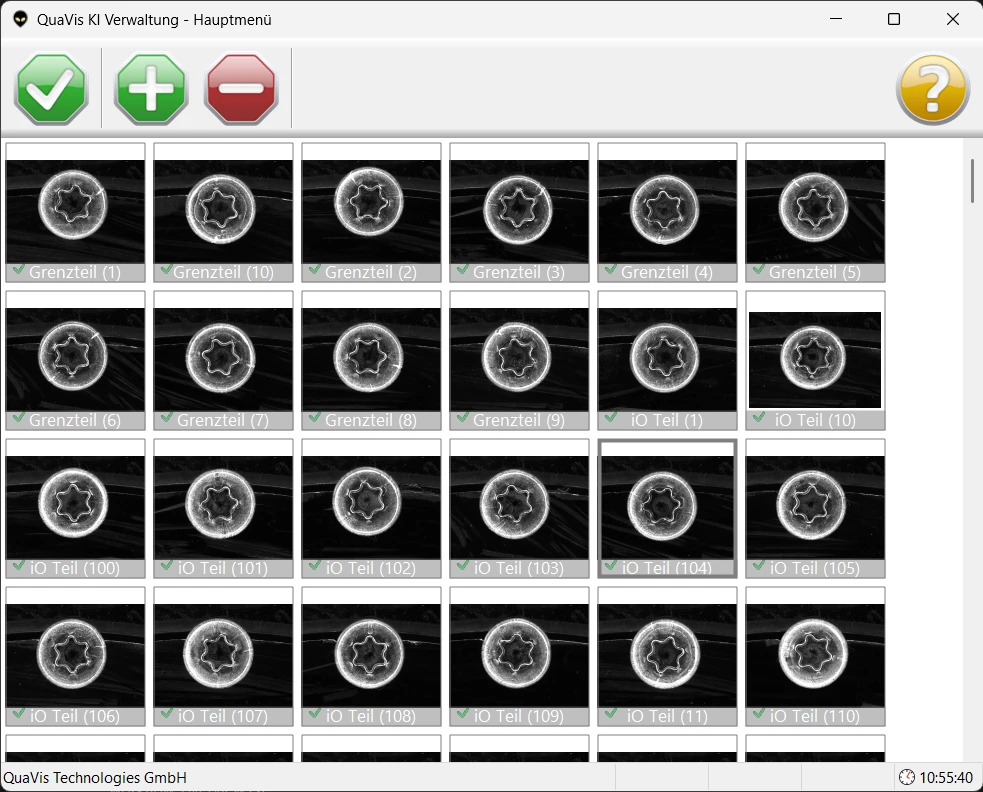
Step 2 — Train the model. One click. QuaVision takes your marked images and trains a Deep Learning model tailored to your specific defects, your specific product, your specific production conditions. Multiple models can be trained with different configurations so you can compare performance.
Step 3 — Deploy to production. Choose the best-performing model and deploy it — again, with a single click. The model runs in real-time on your inspection line, making pass/fail decisions at production speed.
No Python scripts. No Jupyter notebooks. No cloud infrastructure. No data scientist sitting between your quality team and your inspection system.
Why This Works Better Than You Might Expect
The scepticism is understandable. Can a system trained by operators — not ML engineers — really deliver reliable results? The answer is yes, and the reason comes down to what makes industrial inspection different from general computer vision.
In industrial inspection, the problem space is narrow and well-defined. You are not asking the AI to recognise a cat in a photograph. You are asking it to distinguish between a surface scratch and a normal tooling mark on a specific type of metal part, under controlled lighting, at a fixed distance. This is a problem where a focused, well-trained model outperforms a generic one — and where the person with domain knowledge contributes more than the person with ML knowledge.
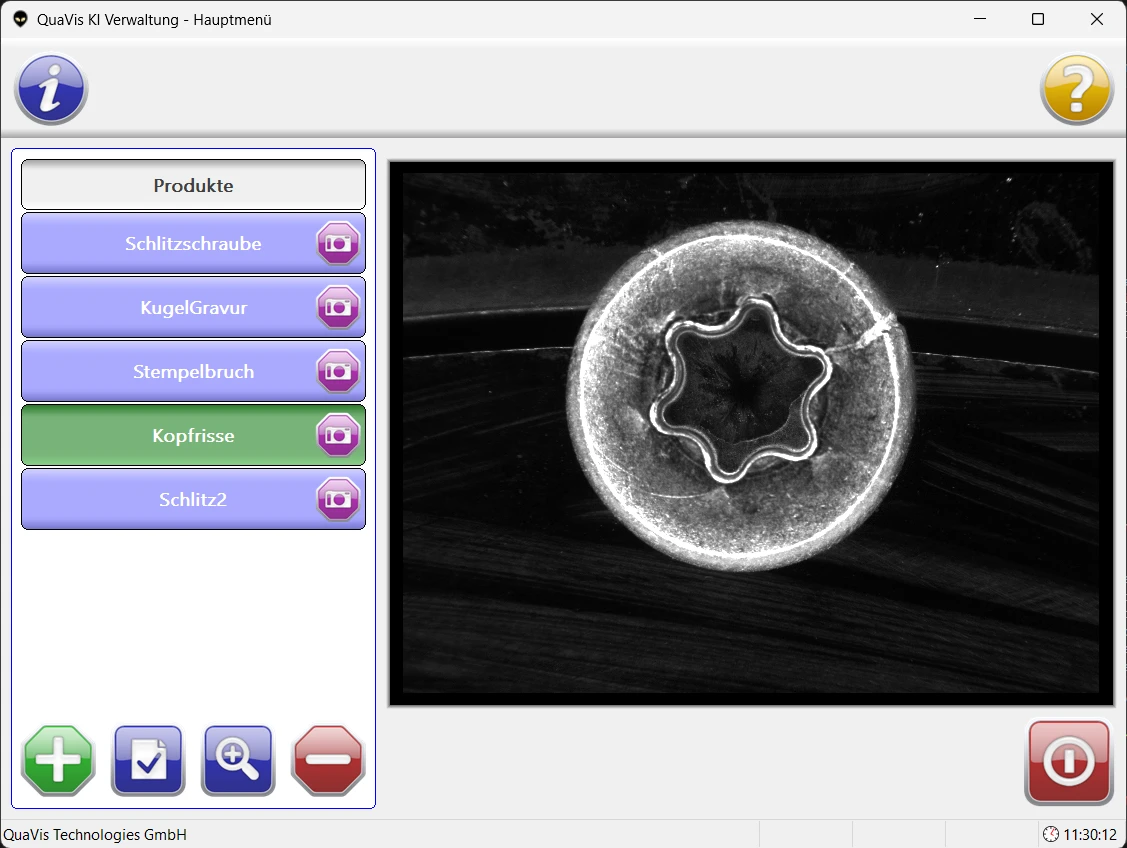
QuaVision leverages open-source AI models that are model-agnostic and framework-independent. This means you are not locked into a proprietary black box. The system supports third-party AI solutions as well, so if your requirements evolve, your options evolve with them.
Adapting to the Real World
One of the most common failure modes of traditional rule-based inspection is sensitivity to change. A slight shift in lighting, a minor variation in part orientation, a new supplier with a marginally different surface finish — and suddenly your carefully tuned thresholds produce false rejects or missed defects.
AI-based inspection handles this fundamentally differently. Because the models learn from real production data — including its natural variations — they are inherently more robust to the conditions that trip up conventional systems:
- Lighting changes — the model has seen parts under varying illumination
- Orientation variations — the model generalises across slight positional differences
- Product variations — surface textures, colour shifts, and material batches are part of the training data, not exceptions to it
And when conditions do change significantly, retraining is not a six-month project. It is a matter of marking new examples and clicking "train" again.
What You Do Not Need
Let us be explicit about what QuaVision removes from the equation:
| Traditional AI deployment | With QuaVision |
| Data science team | Your quality engineers |
| Python / TensorFlow / PyTorch expertise | Graphical interface, no code |
| Weeks of labelling and annotation | Mark defects directly in the GUI |
| Separate training infrastructure | Runs on the QuaVis controller |
| Model deployment pipeline | One-click deploy |
| Vendor lock-in | Open-source, framework-independent |
| Cloud dependency | Runs locally, on-premise |
Built Into a Complete Vision Platform
The AI capability is not a bolt-on module. It is integrated into the full QuaVision platform, which brings:
- Up to 1,500 parts per minute inspection throughput
- 1-micron repeat accuracy for geometric measurements
- Hardware independence — works with any camera, sensor, or lighting system
- A comprehensive toolset of conventional vision tools (edge detection, measurement, pattern matching) that works alongside the AI models
- SQL-based data logging, lot management, and automated report generation
- A GUI translated into 16 languages, touchscreen-enabled, designed for the factory floor
This means you are not choosing between conventional inspection and AI. You are using both — on the same platform, on the same machine, managed by the same operators.
Who Is This For?
If you recognise any of these situations, QuaVision's AI capability was built for you:
- You are inspecting surface defects that are too variable for fixed rules
- Your current system produces too many false rejects and you are sorting manually as a workaround
- You have been told you need AI but you do not have the internal expertise to implement it
- You are retrofitting older machines and want to add AI capability without a complex integration project
- You want to stay in control of your inspection logic — not hand it to an external service provider
See It in Action
The best way to understand what QuaVision's AI training looks like is to see it. We offer live demonstrations — on your parts, with your defect types — so you can evaluate the system on the problems that actually matter to your production.