Why Replace When You Can Retrofit? How We Brought AI Vision to a 30-Year-Old Sorting Machine
The Problem Every Production Manager Knows
Your sorting machine works. It has worked for decades. The mechanics are solid, the operators know it inside out, and it is deeply integrated into your production line. But the inspection quality no longer meets today's standards. Customers demand tighter tolerances. Defect rates that were acceptable ten years ago now trigger complaints.
The obvious answer? Buy a new machine. But the obvious answer is also the expensive one — and not just because of the price tag. A new machine means weeks of downtime, retraining operators, reconfiguring your line, and the risk that comes with every major change. For many manufacturers, that is simply not an option.
There is a better way.
The Project: A 30-Year-Old Sorting Machine, Upgraded in 2 Days
Recently, a customer came to us with exactly this challenge. Their sorting machine was over 30 years old. Mechanically, it was still running reliably. But the original image processing system — built on Windows 3.11 and analog cameras — had become a ticking time bomb.
This is not just a question of outdated performance. It is a question of survival. Spare parts for analog cameras are no longer available. Components for a Windows 3.11-based control system have not been manufactured in decades. Every day the machine ran, the customer was one hardware failure away from an unplanned, indefinite standstill — with no path to repair.
They did not just need better inspection quality. They needed to secure the future of a machine that was still mechanically sound but technologically orphaned.
What We Replaced
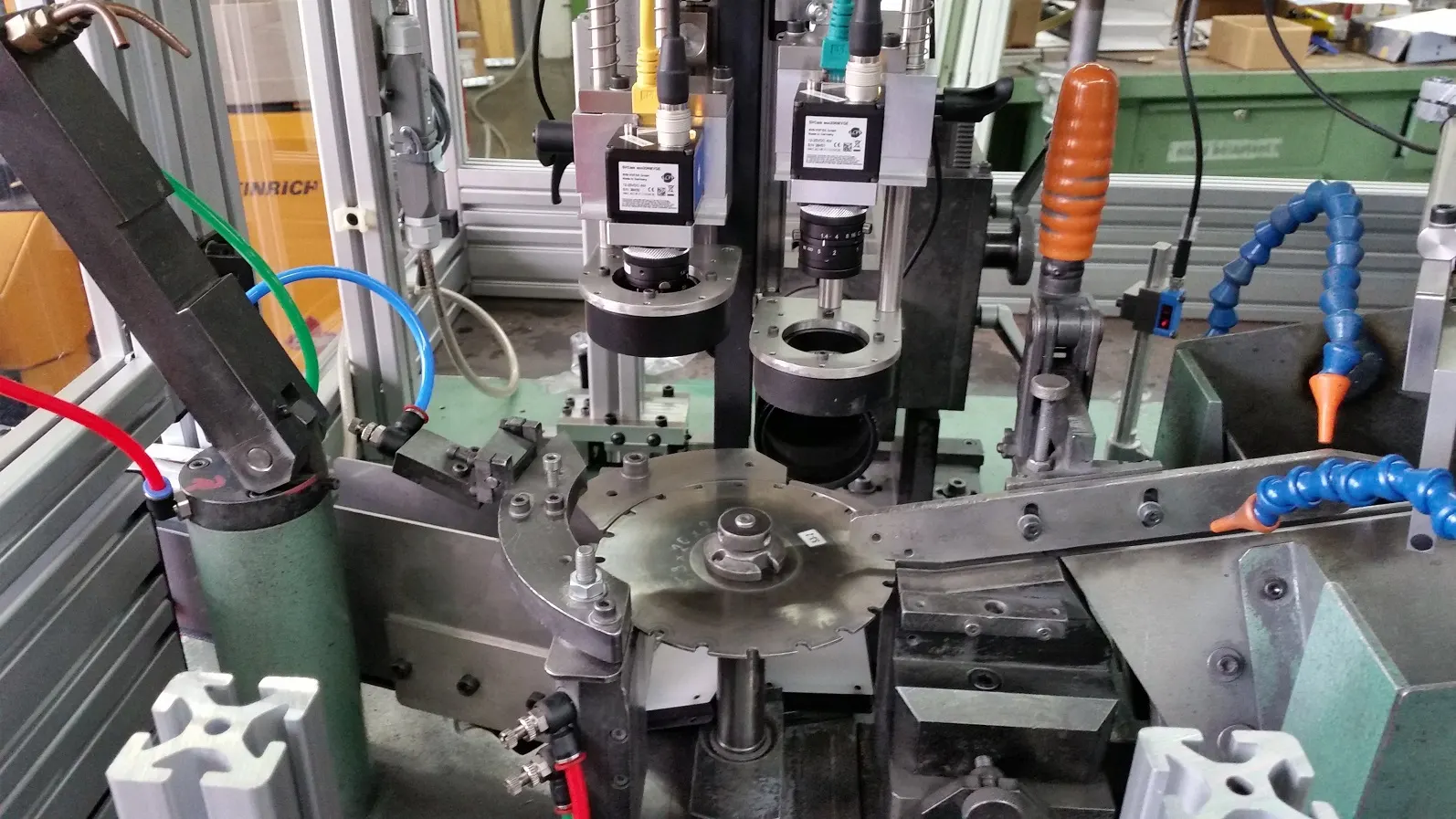
The entire analog image processing system — Windows 3.11 PC, frame grabber cards, analog cameras — was removed and replaced with a modern high-resolution digital camera and a telecentric lens. Telecentric optics eliminate perspective distortion, which is critical for accurate geometric measurement on small parts. Combined with a high-resolution sensor, this single upgrade transformed the machine's ability to detect dimensional deviations and surface defects that the old analog system simply could not see.
A new camera station with a Cognex AI camera was added to the machine. This station uses deep-learning-based image analysis to detect defect types that are difficult or impossible to catch with rule-based algorithms — think subtle surface anomalies, irregular textures, or defects that vary in appearance from part to part. The AI model learns from real production data, which means it gets better over time and adapts to the specific characteristics of each product.
The leap is enormous: from an analog system designed in the early 1990s to state-of-the-art AI vision — on the same machine.
What We Did NOT Touch
This is where it gets interesting — and where the real savings are.
- The machine PLC and electronics were not modified. The existing control system stayed exactly as it was. No rewiring, no reprogramming, no risk of introducing new faults into a proven electrical system.
- Machine operation was not changed. Operators who ran the machine on Friday ran the upgraded machine on Monday. Same controls, same workflow, same sequence. Zero retraining.
- The existing cabinet was not opened or modified. All new components — the QuaVis controller, power supplies, network infrastructure — were housed in a single compact additional cabinet, mounted space-savingly on top of the machine itself. No additional floor space required, no rearranging the production layout.
- Mechanical modifications were kept to a minimum by reusing existing camera mounts and mounting points wherever possible. The new high-resolution camera and telecentric lens were fitted into the original mount positions, avoiding costly custom fabrication and keeping installation time short.
The Glue: QuaVis Controller Integration
The key to making all of this work without touching the existing machine infrastructure is the QuaVis controller. It acts as an intelligent bridge between the new vision components and the legacy PLC. It handles camera triggering, image acquisition, AI inference, and pass/fail decisions — then communicates the result to the existing machine controls through the signals they already expect.
From the machine's perspective, nothing changed. From the quality perspective, everything changed.
Remote Maintenance: Support Without Site Visits
The upgraded system includes remote maintenance capability. Our engineers can access the vision system, update AI models, adjust inspection parameters, and diagnose issues — all without travelling to the customer's site. This reduces response times from days to hours and keeps ongoing support costs low.
It also solves another problem the old system had: when the Windows 3.11 machine needed servicing, finding someone who could work on it was becoming nearly as difficult as finding spare parts for it.
The Numbers That Matter
| Machine age | 30+ years |
| Original system | Windows 3.11, analog cameras |
| Total standstill time | 2 days |
| Cabinets added | 1, mounted on the machine (no floor space needed; existing cabinet untouched) |
| PLC modifications | None |
| Operator retraining | None |
| Mechanical modifications | Minimal — existing mounts reused |
| New capabilities | High-res geometric inspection + AI-based defect detection + remote maintenance |
The Bigger Picture: Retrofit as Strategy
This project is not an exception. It is a model. Across the manufacturing industry, thousands of sorting machines are running with aging vision systems on mechanically sound platforms. Many of them still rely on analog cameras, legacy operating systems, and components that are long out of production. Every one of them is one failure away from a crisis.
Replacing them wholesale is wasteful — financially and environmentally. But doing nothing is a gamble.
At QuaVis, we have been building and maintaining vision systems for industrial sorting machines for over 20 years. We know these machines intimately — their mechanics, their timing, their signal interfaces. That experience is what allows us to retrofit them with modern cameras, AI inspection, and intelligent controllers while keeping risk, cost, and downtime to a minimum.
You do not need a new machine. You need new eyes — and a smarter brain.
Ready to Explore a Retrofit?
If you have a sorting machine that still runs well but no longer inspects well — or if you are worried about spare parts availability for aging vision components — let's talk. We will assess your machine, your inspection requirements, and your budget — and show you what is possible without replacing what already works.